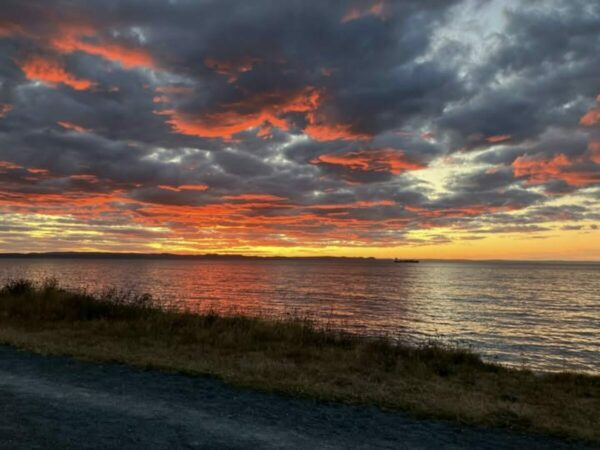
A Newfoundland Weekend Story
“Cod, Company, and a Cup of Tea”
The fog rolled in thick over the bay that Friday afternoon, the kind that clings to your jacket and makes the world feel quieter than it should. But that didn’t stop Uncle Bill from calling out, “We’re still on for tomorrow, b’ys! Cod or no cod!”
Every weekend like clockwork, Bill, his neighbor Elsie, and young Caleb from down the lane would get together for what they called “The Big Go”—a mix of fishing, storytelling, and enough food to feed half of the town.
Saturday morning came early. Elsie showed up in her rubber boots and a wool scarf tied under her chin, holding a tin of tea biscuits “just in case.” Caleb brought his grandfather’s lucky rod, which hadn’t caught a thing in three years but was “blessed with potential.” And Bill? He had the kettle boiling on the propane stove in the shed before anyone could say “morning.”
Out on the boat, the water was calm, the air salty. They jigged for cod, told tales of ghost ships and mummers, and argued good-naturedly over which lighthouse was the best spot to paint. Caleb caught a single cod—small, but it was enough to declare victory. “We’ll eat like kings!” he shouted, holding it high like a trophy.
Back on shore, they fried the cod in a battered old pan while Elsie sliced her biscuits and slathered them with partridgeberry jam. The three of them sat on overturned buckets, steam rising from mugs of Red Rose tea, the kind that tastes better outside for some reason.
“Y’know,” Bill said, squinting toward the water, “it’s not about the fish.”
Elsie nodded. “It’s the sittin’ still. The listenin’. The laughin’. That’s the catch.”
Caleb grinned, stuffing his face. “And the food.”
They laughed till the wind picked up and the first flecks of drizzle came. But they didn’t move right away. It was a Newfoundland weekend—the kind where time slows down, tea tastes like a memory, and friendship feels like home.
A Newfoundland Weekend at the Cabin
“Woodsmoke, Winks, and Weather Talk”
The moment the truck turned off the gravel road and onto the narrow trail leading to the cabin, Sarah exhaled. Not a sigh of weariness, but one of arrival—the kind that only comes when the trees start to close in around you and the air smells like spruce and woodsmoke.
Her husband, Tom, grinned as he shifted into four-wheel drive. “Still think it’s worth the bumpy ride?”
She didn’t answer. She didn’t have to. The little log cabin, nestled near a quiet pond on the edge of nowhere, had been in Tom’s family for three generations. It wasn’t fancy, but it was theirs—a Newfoundland cabin, where time was measured in kettle boils and woodpiles, not clocks.
Inside, it was just as they’d left it: woodstove in the corner, enamel mugs on the shelf, and a framed photo of Tom’s grandfather in his flannel shirt, holding a trout as long as his arm. Sarah set about opening windows while Tom lit the stove and fetched water from the spring. Within an hour, the kettle was singing and the cabin smelled like tea, damp wood, and comfort.
By Saturday morning, the routine kicked in. Bacon crackled in the pan, boots were pulled on with a grunt, and the two of them headed out with their rods. No cellphones. No clocks. Just a thermos of tea, a couple of jam sandwiches, and the call of loons echoing across the pond.
They fished. They laughed. They didn’t say much, but everything important was said anyway.
Later that evening, their friends Pete and Marlene showed up “just for the night” with a guitar, a crock of homemade beans, and a bottle of something that made everyone a little warmer and the stories a little taller.
Around the fire pit, with northern lights whispering overhead and the pond still as glass, they told tales of old ice storms, mischievous moose, and the year the outboard motor fell off the boat “and swam better than we did.”
“You can’t buy weekends like this,” Pete said, passing the mug around.
“Nope,” Tom nodded. “And you can’t explain them either. You just come.”
The next morning came quiet and clear. Sarah stood on the porch, tea in hand, sweater pulled tight, watching the mist lift off the water like breath from the earth.
A Newfoundland weekend at the cabin didn’t need an agenda. It didn’t need Wi-Fi or fine dining. It just needed trees, a warm stove, good friends—and time to remember how beautiful simple can be.
Absolutely, Stephen. Here’s a vivid and heartwarming short story titled “The Iceberg That Stayed Too Long”, capturing the essence of Newfoundland life and wonder:
The Iceberg That Stayed Too Long
“A Cold Visitor, A Warm Memory”
The first time Clara saw it, it was just a glint on the horizon—sharp, white, and glowing like a second moon in the daylight.
“Out there by the tickle,” her grandfather said, pointing from the wharf. “She’s a big one, that. Come all the way down Iceberg Alley just to visit us.”
That spring had come slow, with fog hanging thick over the cliffs and the sea still licking frost off the rocks. But the iceberg had come fast, proud and quiet like a ghost ship from the North.
The whole town of Gull’s Cove took notice. Locals brought binoculars and cameras, and a CBC crew even showed up for a bit of “iceberg tourism” coverage. But after the interviews and oohs and aahs, most folks went back to their lives.
Except Clara.
She visited the wharf every evening after school, sometimes with her sketchbook, sometimes with Nan’s thermos of tea. The iceberg—gleaming blue and white, sculpted like a cathedral—sat in the bay like it had nowhere better to be.
Days turned into weeks. Then a month. The town started calling it “Old Frosty.” “That berg’s got a stubborn streak,” Uncle Len joked at the post office. “Must be half-Newfoundlander.”
But Clara knew better. She felt like it was waiting for something.
That May, Clara’s grandfather passed away peacefully in his chair by the stove. The whole cove showed up to the funeral. Even the wind seemed to hush.
The next morning, the iceberg was gone.
Just like that.
Drifted off in the night, leaving nothing but a shimmer on the waves and the whisper of cold air hanging in its place.
Clara stood alone on the dock, thermos in hand, watching the empty sea. She didn’t cry. She just smiled.
Because she understood now.
That iceberg wasn’t lost.
It had come to keep watch, to stand still while the world moved, to mark a season that would never come again.
Some visitors leave footprints.
Others leave stories.
And some leave a chill in the heart that feels a lot like love.
Home from the Mainland
“Back Where the Salt Air Knows Your Name”
He stepped off the ferry with a duffel bag in one hand and a box of Purity crackers in the other—the kind you can only get on the island unless someone loves you enough to mail a care package across the country.
Daniel had been on the mainland for nearly six years. First it was for university, then work, then… just life. People told him he was smart to leave, that bigger things waited beyond the edge of Newfoundland. And for a while, they were right.
But Newfoundland has a way of calling you home. Not loudly. Not even in words. Just a steady tug in the chest whenever you smell salt air, or hear a fiddle, or sip tea that just doesn’t taste right outside your mother’s kitchen.
His mother met him at the terminal, bundled in her winter coat even though it was only September. “You’re too thin,” she said instead of hello, then gave him a hug that could’ve wrung the ocean out of his coat.
The drive back to the outport was familiar, but full of new potholes and old stories. He saw the church still standing proud above the harbor, the houses still painted like they were trying to outshine each other, and the water—always the water—sparkling like God’s own window.
At the house, Nan had tea on before his boots hit the mat.
“Sit yourself down, love,” she said. “I baked some partridgeberry scones. And I put out the jam you like—the tart one, not the store-bought sweet junk.”
They talked like no time had passed. About Uncle Fred’s moose license, the neighbor’s new siding, the gulls that kept trying to nest in the boat. Not big news—but all the right kind.
Later, Daniel walked out to the wharf. The sun was setting the way only Newfoundland skies can manage—like fire meeting ice. He could hear the water lapping against the rocks, a few kids hollering down the lane, and somewhere far off, someone’s dog barking just for the joy of being alive.
He breathed deep. It smelled like salt, wood smoke, and spruce. Like home.
He didn’t know how long he’d stay. A month? A year? Forever? It didn’t matter.
Because coming home to Newfoundland wasn’t about geography. It was about belonging to something ancient, rugged, and kind. It was about being where people still wave from their trucks, where the kettle is always on, and where the wind speaks your name just right.
Daniel smiled to himself, watching the horizon blur into the sea.
He was home from the mainland—and home was exactly as he remembered.
Certainly, Stephen! Here’s a warm and lively short story titled “The Trouting Trip to Rocky Pond”, celebrating the charm of a classic Newfoundland outing:
The Trouting Trip to Rocky Pond
“Lines Cast, Laughs Shared, and a Lot of Tea”
The plan was simple: leave at sunrise, catch a few trout, boil up by noon, and be home before Nan started calling around asking if anyone had seen you.
Pete, Roy, and young Declan—Roy’s nephew from away—loaded up the old half-ton with rods, worms, rubber boots, and enough Vienna sausages to feed a search party. Declan, being from Ontario, had never been trouting before and thought “Rocky Pond” sounded like something out of a postcard.
“It’s not far,” Pete said, slapping the dash of the truck as it bounced over the rutted trail. “Just past the second bog and over the hill with the crooked birch. You’ll know it when the bugs try to eat your ears off.”
When they finally reached the pond, it was just waking up. Mist rose off the water like it had something to say but was too shy to speak. The air was quiet, except for the gentle plunk of a line hitting water and the occasional slap of a mosquito meeting its end.
Declan cast like he was playing baseball. The worm sailed halfway across the pond. “You’ll scare ’em to Corner Brook!” Roy laughed, then gently showed him the art of the flick—calm wrist, slow reel, and patience.
Trout weren’t biting hard that morning, but that didn’t matter much. Pete pulled in a few pan-sized ones, and Roy caught a keeper with spots that shimmered like oil in the sun.
Declan finally got his first bite near the edge of the reeds. He yanked the rod like he’d hooked a whale, slipped, and fell straight into the pond with a splash and a yelp.
The trout got away, but so did his pride.
They fished a bit longer, then set up a boil-up under a patch of tuckamore. The pan sizzled with trout, onions, and a generous helping of butter. Declan, still soaked but grinning, said it was the best fish he’d ever tasted.
Pete poured tea from the blackened kettle as Roy pulled out a piece of cherry cake. They sat on old logs, steam rising from mugs, boots drying in the sun, and the pond reflecting the sky like it had nothing better to do.
“You’ll remember this, b’y,” Pete said to Declan. “Not ‘cause of the trout. But ‘cause of the day.”
And he was right.
Because a trouting trip to Rocky Pond isn’t just about catching fish—it’s about catching moments. The kind you tuck away for years, like a lucky lure in your tackle box, ready to smile at when the world gets too busy.
Certainly, Stephen. Here’s a heartwarming and humorous Newfoundland short story titled:
Jack’s Old Bird Dog
“Too Slow to Hunt, Too Loyal to Leave”
Everyone in Tickle Cove knew Jack—and everyone knew his old bird dog, Copper.
Copper wasn’t much to look at anymore. His ears drooped like soaked socks, and his legs wobbled when the wind blew sideways. But in his prime, he was a legend. Word had it he once flushed five partridges with a single bark and retrieved a duck that had already frozen to the ice.
But that was years ago.
Now, Copper mostly slept by the woodstove, letting out soft whimpers like he was dreaming of hunts long gone. Jack would pat his head and say, “You’ve earned every nap, me son.”
One fall afternoon, as golden leaves scattered over the hills, Jack decided to go for one more bird hunt—nothing too wild, just a slow walk up behind the old wharf road.
“You stay put,” he told Copper, filling his thermos. “You’re retired now.”
But when Jack turned to leave, he heard the click of toenails on the floor, followed by a wheezy huff. Copper was already at the door, tail wagging, eyes full of something that looked a lot like pride.
“Well,” Jack muttered, “you’re stubborn as ever.”
They made their way into the brush. Jack moved slow; Copper moved slower. The gun wasn’t loaded—Jack wasn’t all that interested in shooting anything. He just liked the feeling of being out there, like he used to be, with the dog who’d never let him down.
An hour in, they came to a clearing. Jack sat on an old stump and poured some tea. Copper lay at his feet, tongue out, chest heaving but happy.
That’s when it happened.
A rustle. A flutter. And before Jack could blink, Copper was up—half tripping, half charging—toward a clump of brush. Out flew a partridge, startled as sin, wings flapping like someone had set fire to its tail.
Copper stood panting, triumphant, nose in the air.
Jack didn’t raise his gun.
He just laughed. Loud and deep, like he hadn’t in years.
“You still got it, old boy.”
They didn’t bring home a bird, but that wasn’t the point. They brought home a memory. The kind that sticks to your ribs like Nan’s pea soup.
That winter, Copper slept more and barked less. And one morning, he didn’t get up at all.
Jack buried him up by the clearing, under the trees where the birds still fly.
And every fall after, Jack would walk up behind the wharf road with a cup of tea and an empty leash, smiling at the trees, waiting to hear a rustle in the brush.
Because some dogs don’t just point at birds.
They point your heart back to all the best things you ever knew.
A lighthearted and reflective poem titled “The Weekend”, blending rest, renewal, and a touch of faith:
The Weekend
Some gather with their friends or kin,
Some seek a place to breathe within.
For bodies ache and hearts grow thin—
The soul cries out for peace again.
And in this pause, a whisper flows,
A holy hush the spirit knows.
For rest was not man’s idle claim—
God rested too and blessed His name.
So take the time, enjoy the grace,
Let burdens fall and joy embrace.
The weekend comes not just to end,
But to restore, renew, and mend.